 English
 हिन्दी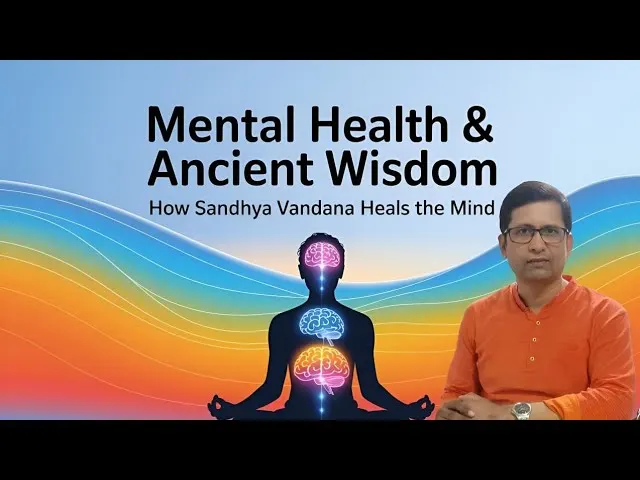
Mental Health and Sandhya Vandan: Scientific Understanding with the Grounding Technique

During the festive season, especially on a sacred occasion like Ganesh Chaturthi, the connection between mental or “manas” health and Indian traditions is felt more deeply, and in this context the caption presents reflections on “Manas Health and Sandhya Vandan.” This perspective encourages viewing the small rituals of the sandhya period not merely as worship procedures, but as a practical process of sensory reorientation and connecting with nature.
The core point of “Manas Health and Sandhya Vandan” is that rituals performed during the day’s transition periods—sunrise, midday, and sunset—steady the mind and senses, which in modern language aligns with grounding. Supplementary context: India’s National Mental Health Survey 2015–16 estimated lifetime prevalence of mental disorders at about 13.7% and current prevalence at 10.6%, underscoring the relevance of simple, culturally rooted practices.
The essence of “Manas Health and Sandhya Vandan”
The caption clarifies that “sandhya” means the period of junction—when phases like night to morning (sunrise), midday, and sunset meet one another—and that brief, structured rituals are prescribed during these moments. The purpose of these rituals is to awaken our senses and connect them to nature so that the mind remains steady and energy is replenished.
This statement advances the core message of “Manas Health and Sandhya Vandan” that such subtle rituals, when made part of a healthy routine, nurture mental resilience and calm. The caption also reminds that in severe situations, seeking qualified medical assistance is necessary.
Grounding technique and its alignment with Sandhya Vandan
Modern “grounding” techniques are strategies that anchor the senses in the present moment, bringing stability during stress, panic, and restlessness. In the 5-4-3-2-1 method, attention is guided through seeing, touching, hearing, smelling, and tasting in sequence to help calm the nervous system.
In line with the caption, the activities performed during Sandhya Vandan—adorning the deity/altar (visual), using instruments/mantras/bells (auditory), incense/flowers/aromatic substances (smell), tilak/paste/tactile elements (touch), and receiving prasad (taste)—offer a real example of integrated sensory reorientation. In this way, “Manas Health and Sandhya Vandan” naturally appears consistent with the principles of sensory-based grounding.
Practical tips: Ways to integrate 5-4-3-2-1 into Sandhya Vandan
- See 5 things: Observe the altar/sky/natural light/colors/shapes attentively, and identify one subtle detail each time.
- Touch 4 things: Feel the texture of the seat, water, flowers/leaves, or fabric.
- Hear 3 sounds: Listen to chanting, a bell, or surrounding natural/environmental sounds.
- Identify 2 smells: Focus on the fragrance of incense, flowers, sandalwood, or fresh air.
- Attend to 1 taste: Savor the taste of water or prasad and rest in the present moment.
(Supplementary context) In clinical/counseling settings as well, this 5-4-3-2-1 structure is taught as a simple, evidence-supported technique, found helpful for mindfulness and calming the nervous system.
Mental health in India: supplementary context
According to the National Mental Health Survey (2015–16), lifetime prevalence of any mental disorder was estimated at about 13.7% and current prevalence at 10.6%, aligning with the “about 10–15%” statement mentioned in the caption. This survey covered 39,000+ people across 12 states and brought forth several important findings, including treatment gaps, emphasizing the need for simple, accessible, and culturally engaging interventions.
Topics like “Manas Health and Sandhya Vandan” are also relevant because community-based, time-efficient practices can be followed in daily life and provide a supportive non-pharmacological option, while professional care remains essential in severe situations.
Rituals and mental calm: what research suggests
(Supplementary context) Controlled studies have found that structured rituals may be associated with reductions in anxiety—some field and laboratory findings observed improvements in self-reported anxiety and physiological indicators (such as HRV) in ritual conditions. Along the same lines, pre-performance rituals have shown positive effects on performance and neural responses through anxiety reduction, although the magnitude and context of effects vary across studies.
This literature suggests that structured, repetitive, and meaning-rich practices like “Manas Health and Sandhya Vandan” can be beneficial for psycho-physiological stability, particularly in contexts of uncertainty and stress.
The three sandhya phases:
The three junction periods—sunrise, midday, and sunset—are designated in Indian tradition for special rituals whose essence is to balance the senses and the mind. If “Manas Health and Sandhya Vandan” is practiced at these time points, it can become a subtle yet effective grounding practice integrated into the daily routine.
Conclusion
“Manas Health and Sandhya Vandan” rests on the understanding that traditional rituals of the sandhya period align with modern grounding principles and steady the mind through integrated sensory reorientation. Based on supplementary references, such cultural practices can be useful as non-pharmacological support; please watch the video, share/comment on the article, and explore our blog for related content.
Disclaimer: This material is for educational purposes; in any serious situation, consult a qualified Ayurveda practitioner or mental health professional, as the original caption also suggests.
Reference list (official sources)
National Mental Health Survey of India 2015–2016 — Overview of prevalence and methodology — (NIMHANS/PMC)
5-4-3-2-1 Coping Technique for Anxiety — Sensory-based grounding guide — (University of Rochester)
Grounding Techniques — Client handout/article — (Therapist Aid)
The role of ritual behaviour in anxiety reduction — Controlled field study — (Proceedings B)
Rituals improve performance by decreasing anxiety / Rituals decrease the neural response to performance failure — Experimental research — (HBS/PNAS)

thanks for info.
Keep reading relevant topic and share you valuable feedback